Island Council Meets with Dutch Prime Minister Rob Jetten During Official Visit to Saba
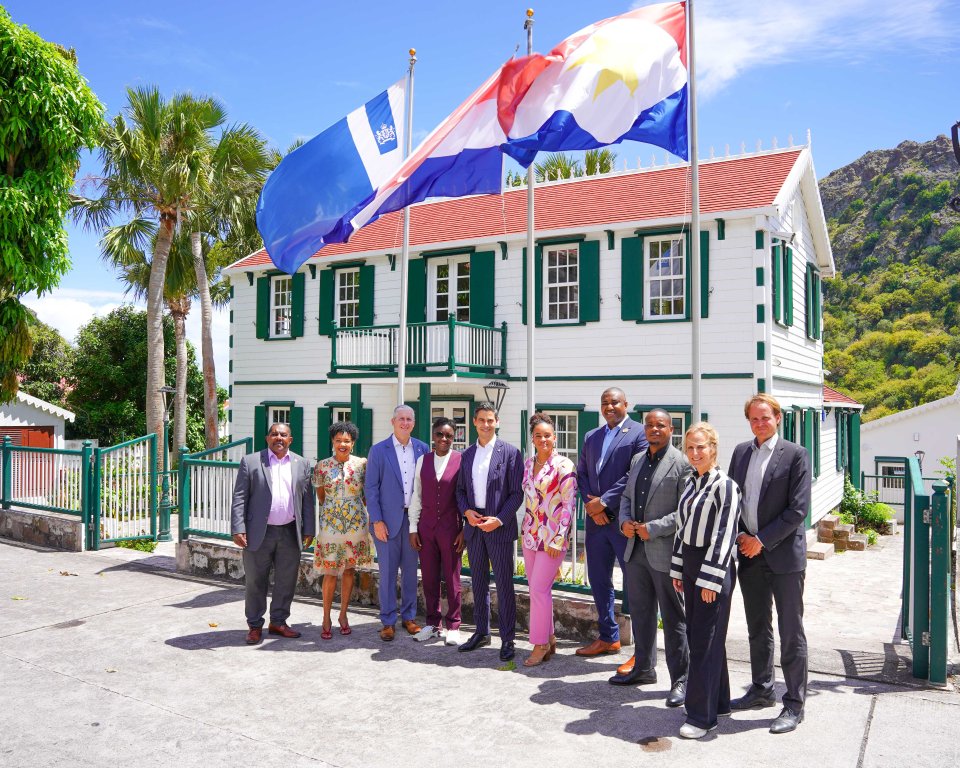
On Sunday, May 10, 2026, Island Governor Jonathan Johnson and members of Saba’s Island Council, Elsa Peterson, Saskia Matthew, Vito Charles, Julio Every, Rolando Wilson and Island Registrar Akilah Levenstone met with Dutch Prime Minister Rob Jetten during his first official visit to Saba as Prime Minister of the Netherlands.
The meeting provided an opportunity for the Island Council and Prime Minister Jetten to engage in key issues impacting the island. Discussions were held in an open setting and focused on sustainable development, accessibility and connectivity, cost-of-living challenges, governance, housing, energy prices, climate change, and the ongoing partnership between Saba and the Government of the Netherlands.
The Council addressed the increasing cost of living on Saba and mentioned how prices have risen, particularly due to ongoing global developments. Prime Minister Jetten indicated that funding would be made available to assist with addressing the cost-of-living challenges on the islands, with more details to follow.
Connectivity between the islands was also a point of discussion. The Council pointed to the importance of establishing a Public Service Obligation (PSO), which could help lower Winair fares and improve accessibility within the region.
The council also touched on the importance of maintaining both Winair and the Makana ferry services, as having multiple transportation options is essential for reliable inter-island connectivity.
Housing was another topic of discussion. While the Council acknowledged that there is a place for social housing, it was emphasized that greater focus should also be placed on developing more mid-market housing, including both rental properties and homes for purchase. The Council mentioned that many working people on Saba are currently feeling the greatest pressure with the housing market.
The meeting also touched on the recent United Nations resolution related to slavery and reparations, particularly the fact that the Netherlands, along with several other European countries, abstained from the vote. This formed part of a broader discussion on historical responsibility and ongoing dialogue within the Kingdom.
Lastly, discussions were held regarding energy prices and the continued impact that residents are facing, as well as concerns related to climate change and the importance of long-term sustainability and resilience.
